
Abhilasha Samiti
Pithoragarh (Uttarakhand)
Abhilasha Samiti, Pithoragarh (Uttarakhand), is dedicated to empowering communities through education, social welfare, and development programs for a brighter, self-reliant future.”
Abhilasha Samiti
Vision
Always write benefits over features. Mention all the benefits or services with some real examples. Focus on how you can help and benefit your user. Use simple words so that you don’t confuse people. Say as much in as few words as possible.

Mission
Focused on Uttarakhand Himalayas, especially remote areas of Pithoragarh. Running schools in villages with poor education facilities, preventing migration, and implementing developmental activities in 50+ villages.
History and Background
History and Background
Women Empowerment, Culture, Gender and also Conduct Public Awareness Campaigns for Right to education, Providing employment oriented training for Self Help Group and creating groups.
ABHILASHA SAMITI is a voluntary organization established informally in year 2007-2008 and formally 2019-2020, Organization under Indian Societies Registration Act 21, of 1860.
ABHILASHA SAMITI’s level of action is National, recently working in rural and urban areas of Pithoragarh district and also in other district of Uttarakhand (like Champawat, Almora, Bageswar, Munsyari, etc).
We are working for our motto “A small step can change lots of life” in India. The main mission of the Society is to promote education, health-care services and give harmony, prosperity and happiness in family life of backward & poor families.

DR. KISHOR KUMAR (PRESIDENT)
As I look back on the years gone by, this journey appears not merely as a personal experience but as a collective resolve, a sustained pursuit of social transformation, and the shaping of a shared vision. What began in 2001–2002 as the humble efforts of a grassroots volunteer has today evolved into more than two decades of service, learning, and nation-building.
In the early years, I immersed myself in training through various national and regional institutions and soon felt compelled to return that learning to society through community-based programs. My first chapter was written among self-help groups and Swa-Shakti collectives, where I worked to awaken rural communities, guide them toward self-reliance, and help them recognize the latent potential within.
While working across villages in Uttar Pradesh, Rajasthan, and Madhya Pradesh, I realized that India’s true strength resides in its villages. It is the resilience of rural women, the industrious spirit of youth, and the unbound imagination of children that hold the power to define India’s future. Thus, when in 2005–2006 I was entrusted with the responsibility of coordinating the National Rural Health Mission project in Didihat block of Pithoragarh district, I did not see it as a routine assignment but embraced it as a people’s movement.
Over three years, the experience reaffirmed that health is not merely a medical concern; it is deeply intertwined with education, livelihood, and social awareness.
These realizations inspired me to take concrete steps in the field of education. The harsh reality of rural education stirred my conscience. Schools existed, yes—but education lacked meaning, purpose, and transformative impact. To address this void, Abhilasha Academy was born. Its vision was not confined to formal schooling; rather, it sought to make education a value, a way of life, and a foundation for self-reliance. Providing free education to underprivileged children, distributing books at no cost, and creating an environment conducive to joyful learning was not simply a service to us—it was our duty and our responsibility toward society.
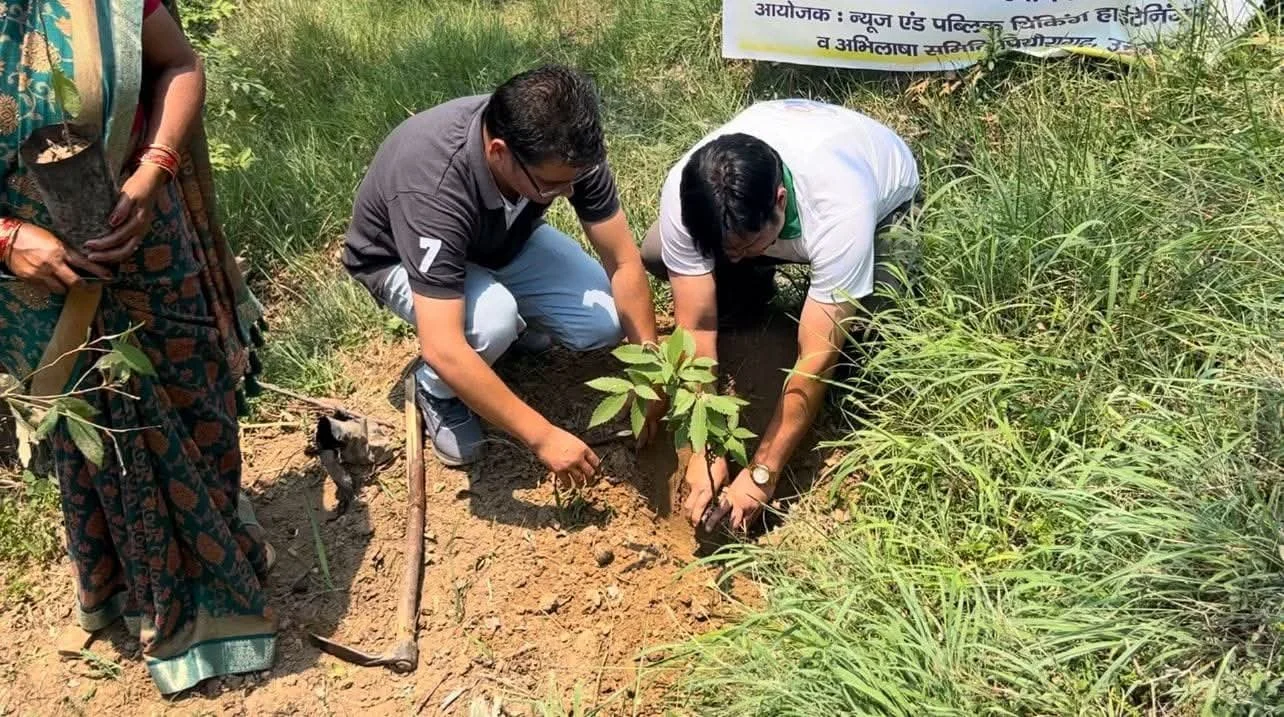
Alongside educational initiatives, the Abhilasha Committee expanded its role into livelihood promotion and awareness-building, leading to yet another milestone—the Fire-Free Himalaya Campaign. Through signature drives, painting competitions, plantation programs, and biodiversity conservation activities with children, this movement sowed seeds of ecological sensitivity and responsibility in young minds. Today, when thousands of children stand committed to environmental protection, we consider it our greatest reward.
For me, the vision of a strong and prosperous society is not confined to documents or speeches. I firmly believe that every hand must be engaged in self-employment. If we equip our youth with opportunities to become creators of livelihoods rather than seekers of jobs, every village in India can brim with dignity and pride. True success of welfare schemes, whether of the central or state governments, lies in embedding the spirit of self-reliance and entrepreneurship into their core.
In pursuit of this belief, we have organized countless workshops and training programs on livelihood, women’s empowerment, and health awareness. The results have been profoundly encouraging—women stepping into financial independence through self-help groups, youth discovering sustainable livelihoods within their own villages, and communities developing preventive approaches to health care. These outcomes reaffirm the principle that when society is guided with opportunities and direction, positive change becomes inevitable.
This two-decade journey is not merely a chronicle of statistics or projects. It is the story of smiling children enlightened by education, of women empowered to embrace independence, of young people who chose self-reliance over migration, and of children who dreamt of lush green forests and pristine rivers.
Today, Abhilasha Samiti stands not just as an institution, but as a symbol of collective responsibility and social consciousness. We firmly believe that true social upliftment cannot be achieved by government efforts alone, but only through the active participation of civil society. In the years ahead, we pledge to deepen and expand our efforts in education, health, livelihood, and environmental conservation, touching lives with greater impact and inclusivity.
My heart is filled with profound gratitude toward every colleague, trainer, teacher, student, and community member who has walked with us on this journey.
Our dream is not simply to build an organization, but to help shape a society where every child has access to education, every woman enjoys self-reliance, every youth is engaged in meaningful self-employment, every family is healthy and empowered, and every hand bears the responsibility of protecting nature.
Let us come together to build such a society—self-reliant, compassionate, and inspiring—for the generations to come.
With warm regards,
Dr. Kishor Kumar Pant
President/Director
Abhilasha Samiti, Pithoragarh, Uttarakhand
Genesis of the Organization
Vision
We are working for our motto “A small step can change lots of life” in India. The main mission of the Society is to promote education, health-care services and give harmony, prosperity and happiness in family life of backward & poor families. To provide help & support to the children, widows, sick person, old aged helpless and indignant persons are the target people of our Society.
We are working for our motto “A small step can change lots of life” in India. The main mission of the Society is to promote education, health-care services and give harmony, prosperity and happiness in family life of backward & poor families. To provide help & support to the children, widows, sick person, old aged helpless and indignant persons are the target people of our Society
Mission
Organization have focused its activities in Uttarakhand Himalayas, mainly in the remote areas of district Pithoragarh of Uttarakhand, Where a programme implementation office is established and a devotee team of voluntaries is working. Organization is running a school in remote villages, where education facilities are not enough and rural people are migrating for education towards district head quarter and other where. Organization have selected two major clusters for development within the district which includes 50 villages and implementing different developmental activities, including education support, awareness programmes, livelihood promotion, women empowerment, and health improvement, with a vision to build sustainable and self-reliant rural
